
Grounding Techniques for Anxiety: Box Breathing, Emotion Surfing and Healthy Distraction
Anxiety, stress and overwhelming emotions can make it difficult to think clearly. Attention can be drawn towards worries, intrusive thoughts or uncomfortable physical sensations, making it harder to stay connected to the present moment.
Grounding techniques are practical strategies that help redirect attention away from these experiences and back to what is happening here and now. They can to reduce the likelihood of becoming caught in cycles of rumination or escalating anxiety.
Like any skill, grounding techniques become more effective with regular practice.
Colour Grounding
Colour grounding is one of the simplest grounding exercises and can be practised almost anywhere.
Begin by choosing one colour, for example, blue.
Now slowly look around your environment and identify everything you can find in that colour. As you notice each object, name it either aloud or silently.
For example:
- Blue notebook
- Blue pen
- Blue car
- Blue shoes
Continue for as little or as long as you feel necessary.
Why does it help?
When we become anxious, our attention naturally narrows towards perceived threats, worries or distressing thoughts.
Searching for a specific colour asks your brain to perform a different task. Instead of following anxious thinking, it begins scanning the environment, recognising objects and processing visual information.
Each time you intentionally redirect your attention, you reinforce the habit of returning to the present moment. With repeated practice, this may gradually reduce the automatic pull of well-established negative thinking patterns while strengthening your ability to consciously shift your focus elsewhere.
The aim is to practise choosing where your attention goes.
Colour Grounding
Choose one colour
↓
Slowly scan your surroundings
↓
Find matching objects
↓
Name each object
↓
Attention eventually returns to the present
Box Breathing
Box breathing combines slow, controlled breathing with a simple visual guide.
Rather than counting seconds, imagine tracing the outline of a square with your finger. You can trace the square in the air, on your leg, or by looking at a printed square.
Instead of tracing one side for each stage of the breath, trace the entire square during each part of the breathing cycle. The time it takes to complete one full lap naturally becomes the timing for that stage of the breath, removing the need to count.
How to practise:
Step 1
Breathe in slowly while tracing the entire outline of the square once.
Step 2
Hold your breath while tracing the entire square again.
Step 3
Breathe out slowly while tracing the entire square a third time.
Step 4
Hold your breath once more while tracing the entire square for a final time.
You have now completed one full breathing cycle.
Repeat the cycle as many times as necessary- some people have used this practice for up to 20 mins when struggling to sleep due to intrusive thoughts.
Why does it help?
Slow, controlled breathing can promote a calmer state.
The square acts as a visual pacing guide, your attention is focused on tracing the shape. The movement around the square naturally determines the length of each stage of the breathing cycle, making the exercise easier to remember and easier to use when feeling anxious or overwhelmed.
Emotion Surfing
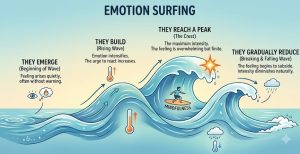
Strong emotions often feel as though they will continue indefinitely.
Emotion surfing is based on recognising that emotions usually follow a predictable pattern.
They emerge.
They build.
They reach a peak.
They gradually reduce.
The aim is not to stop or control the emotion.
Instead, observe it with curiosity while recognising that it is following a natural process.
Rather than asking,
"How do I make this feeling stop?"
Try asking,
"Where am I on the wave?"
Knowing that emotions naturally rise and fall can reduce the fear that often accompanies them.
The objective is not to change the emotion while it is happening.
Instead, notice it, allow it to move through its natural cycle, and remind yourself that emotions (however intense) -do not remain at their peak forever.
Healthy Distraction
Distraction is sometimes viewed as something to avoid, but it can be a helpful coping strategy when used appropriately.
There is an important difference between avoiding emotions indefinitely and using distraction to temporarily reduce emotional intensity.
When emotions become overwhelming, clear thinking becomes more difficult. A healthy distraction can provide enough mental space for the intensity to reduce before returning to the situation.
Examples include:
- Going for a walk
- Listening to music
- Reading
- Completing a crossword or puzzle
- Gardening
- Stretching
- Cooking
- Speaking with a friend
- Making a cup of tea/ coffee while paying attention to each step
The goal is to reduce emotional intensity sufficiently so that you can return to the situation with greater clarity and perspective.
Healthy Distraction
Emotion becomes overwhelming
↓
Choose a healthy distraction
↓
Emotional intensity reduces
No single technique works for everyone or in every situation, so it can be helpful to experiment and discover what works best for you. The more regularly you practise these skills, the more accessible they become for when you need them most.